PCB Rules
Round vs Square Pads
Round pads give a strong joint, this mattered less for leaded solder, but it is increasingly important for lead free pastes. Surface tension makes the solder prefer the ball shape and is supported by the circular pad. The square pad is weaker because the tension is unevenly distributed through the solder.
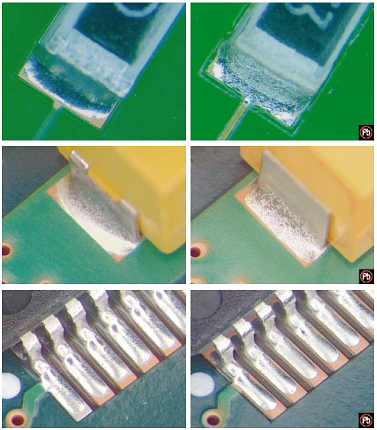
Pb vs no-Pb
Some CAD tools support only oblong rectangles and not rounded rectangle pad shapes which are recommended in IPC-7351 standard. In any case, oblong rectangle is still better than the squared one.
Rules for Rounded Rectangle:
- Corner Radius = 25% of pad width
- Maximum Radius = 0.25 mm
- Radius Corner Round-off = 0.01 mm
Aperture Filling
Squeegee angle should be between 50 and 60. For smaller components, such as 0201 and 0420, paste type 6 (10 µm) and type 5 (15 - 25 µm) is better option.
- Type 4 has 20% more of surface area compared to type 3, so there is no such large benefit
- Type 5 has 75% more of surface area compared to type 3

Note: Source Yamaha Motor
Tombstoning of 0402
- Component body must cover > 50% of both pads, underwise there is high tendency to have imbalance wetting force resulting in tombstoning.
- Unequal pad size means different solder volume, increasing potential for unequal wetting force. If unequal pad size is used e.g. due to design limitation, ensure that the soak zone extends for a minimum of 30 seconds (a gradual soak ramp rate just before reaching liquidus point, e.g., SAC305, soak @ 190-220°C for 30-45 sec).
- Check other components placement accuracy. Skew placement will create imbalance wetting force on both pads.
Mid-chip Solder Balls